Home / Agentic commerce
Get your store ready for AI shopping agents
AI assistants can now search, compare and, in some cases, buy on a shopper’s behalf. They choose stores whose data they can trust. We make sure yours is one of them.
- Catalog and feed readiness
- Policy and checkout checks
- Agent channel reporting

What agentic commerce means
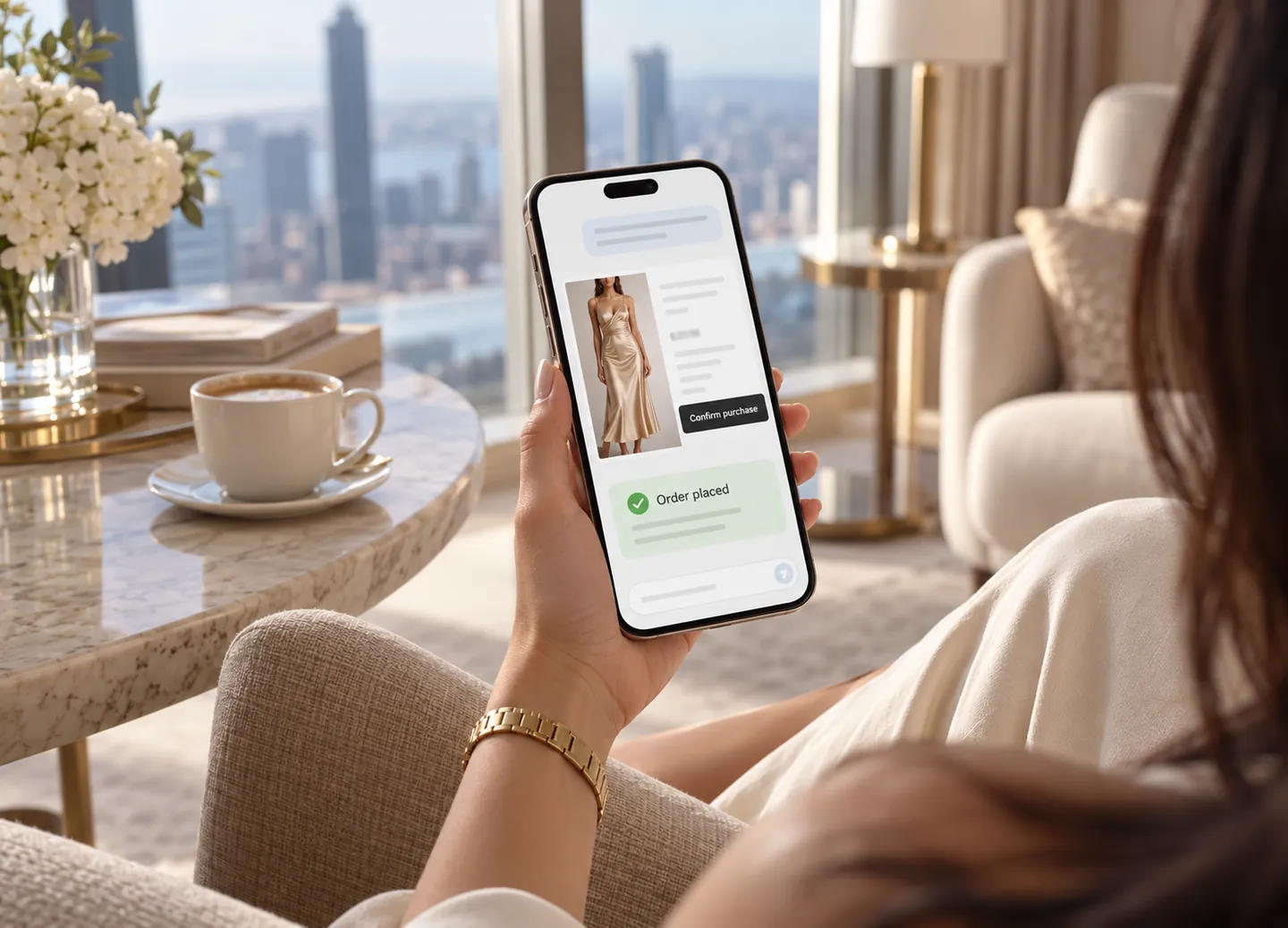
Agentic commerce is shopping where an AI agent does part of the work for the customer. The shopper says what they want, something like “a champagne satin midi dress under $200, in size M, that arrives before Saturday’s wedding”, and the agent searches stores, compares options, checks stock and delivery, and in some cases completes the purchase.
The infrastructure for this moved quickly over the last year:
- In September 2025, OpenAI and Stripe released the Agentic Commerce Protocol, an open standard for agents to buy from merchants.
- In January 2026, Google and Shopify announced the Universal Commerce Protocol, covering discovery, carts, checkout and post-purchase.
- In March 2026, Shopify switched on Agentic Storefronts by default for eligible US stores, making their products discoverable in assistants including ChatGPT, Microsoft Copilot, Google AI Mode and Gemini.
- Also in March 2026, OpenAI scaled back in-chat checkout, sending shoppers to the merchant’s own checkout instead.
What agents look at
An agent can’t squint at a photo or guess what “fits true to size, mostly” means. It works from structured data and clear text. When it compares your product with a competitor’s, it looks at:
Complete product data
Titles, categories, materials, dimensions, variants, GTINs and compatibility, filled in and consistent.
Live price and stock
The same price in your feed, on your page and in your structured data, with stock that’s actually accurate.
Delivery and returns
Shipping costs, delivery times, return windows and warranty terms in a form a machine can read.
Reputation
Review volume and ratings, plus what independent sources say about you.
Our agent readiness audit
We check your store against the things that decide whether an agent can find, trust and buy from you. Here’s what we look at and what we usually find:
| Area | What we check | Common problem |
|---|---|---|
| Catalog | Product categories, attributes, metafields, variants | Key details only in images or long descriptions |
| Feeds | Merchant Center and Shopify Catalog data quality | Missing GTINs, vague titles, disapproved items |
| Consistency | Price and stock across feed, page and schema | Sale prices that don’t reach the feed |
| Policies | Shipping, returns, warranty, contact details | Policies missing or written as vague marketing copy |
| Checkout | Payment options, address handling, fraud rules | Fraud filters blocking legitimate agent-placed orders |
| Measurement | Order source tags, channel reports, UTMs | Agent orders lumped in with direct traffic |
Fixing the catalog
Most of the work is unglamorous and makes a real difference. We map every product to Shopify’s standard product taxonomy, move key details out of descriptions and into structured fields, fill in missing attributes, and write titles and descriptions that state facts plainly.
For larger catalogs we build enrichment workflows, so new products arrive complete instead of being fixed months later. The same work improves your Google Shopping performance and your on-site search, so it pays off even before agent traffic grows.
Policies and checkout
An agent buying on someone’s behalf needs to know exactly what happens after the order. We rewrite shipping, returns and warranty policies so they’re specific: costs, timelines, conditions and exceptions. Then we make sure they’re linked and marked up where agents look for them.
On the checkout side, we review payment methods, address validation and fraud rules. Agent-placed orders can look unusual to older fraud filters, and you don’t want to cancel good orders by accident.
Measuring agent-driven sales
We set up reporting so you can see orders from AI channels separately: by sales channel in Shopify, by referral source in GA4 and by survey response after purchase. It’s early, so volumes are still small for most stores. Tracking it now means you’ll spot the trend when it starts, rather than months later.
Who should do this now
Agentic commerce matters most right now if you sell products with clear specifications that people compare: clothing with clear sizing and fabrics, outdoor gear, electronics accessories, supplements, skincare, home goods, parts and consumables. If you sell custom or very high-consideration products, the basics are still worth doing, because the same work improves your Shopping ads and AI visibility today.
Questions about agentic commerce
Is my Shopify store already in ChatGPT?
If you’re an eligible US merchant, quite possibly. Shopify switched Agentic Storefronts on by default for eligible US stores in March 2026. Being listed and being chosen are different things, though. That depends on your data, policies and reputation.
Do I need a developer for this?
For most Shopify stores, no. The work is mainly in product data, metafields, feeds and settings. Custom or headless stores may need some development, and we’ll tell you upfront if yours does.
Which protocols do we need to support?
On Shopify, the platform handles the protocol side for you. On other platforms it depends on which assistants matter to you. The groundwork, clean product data and clear policies, is the same either way.
Will agents replace my website?
Not any time soon. For now, agents are another route to your products, alongside search, social and email. Stores that are easy for agents to read also tend to be easier for people to shop.
How do we know if agent orders are happening?
We set up order source tracking and channel reporting so agent-driven orders show up separately in Shopify and your analytics.
Is your store ready for AI agents?
We’ll run our readiness audit on your catalog, feeds, policies and checkout, and send back a scored report with fixes.
Works well alongside
Get a free audit
Tell us a little about your business. A strategist will look at your site and accounts, then come back within one business day with a time to talk.
What happens next
- We look over your site and public ad activity before we speak.
- On a 30-minute call we walk through what we found and where money is leaking.
- You get a written 90-day plan. It’s yours whether or not you hire us.
Prefer email? Write to theadstroke@gmail.com