Home / Meta Ads
Meta Ads that keep finding new customers
Facebook and Instagram ads built on a steady supply of tested creative and clean conversion data. We treat creative as the main lever, because on Meta it is.
- Weekly creative testing
- Conversions API set up and monitored
- Lead quality tied to your CRM

What changed on Meta
A few years ago, Meta advertising was about finding the perfect audience: interests, lookalikes, careful exclusions. That job has mostly moved to Meta’s own algorithm. Broad targeting now beats hand-picked audiences in most accounts we see.
That leaves four inputs that really move results, and they’re the four we spend our time on:
- Creative. The ad itself now decides who sees it. Different hooks reach different people.
- Signal. How accurately Meta sees purchases or qualified leads, and what each one is worth.
- Offer. What someone gets for acting now, and how clearly the ad says it.
- Structure. How budget is split between testing new ideas and scaling proven ones.
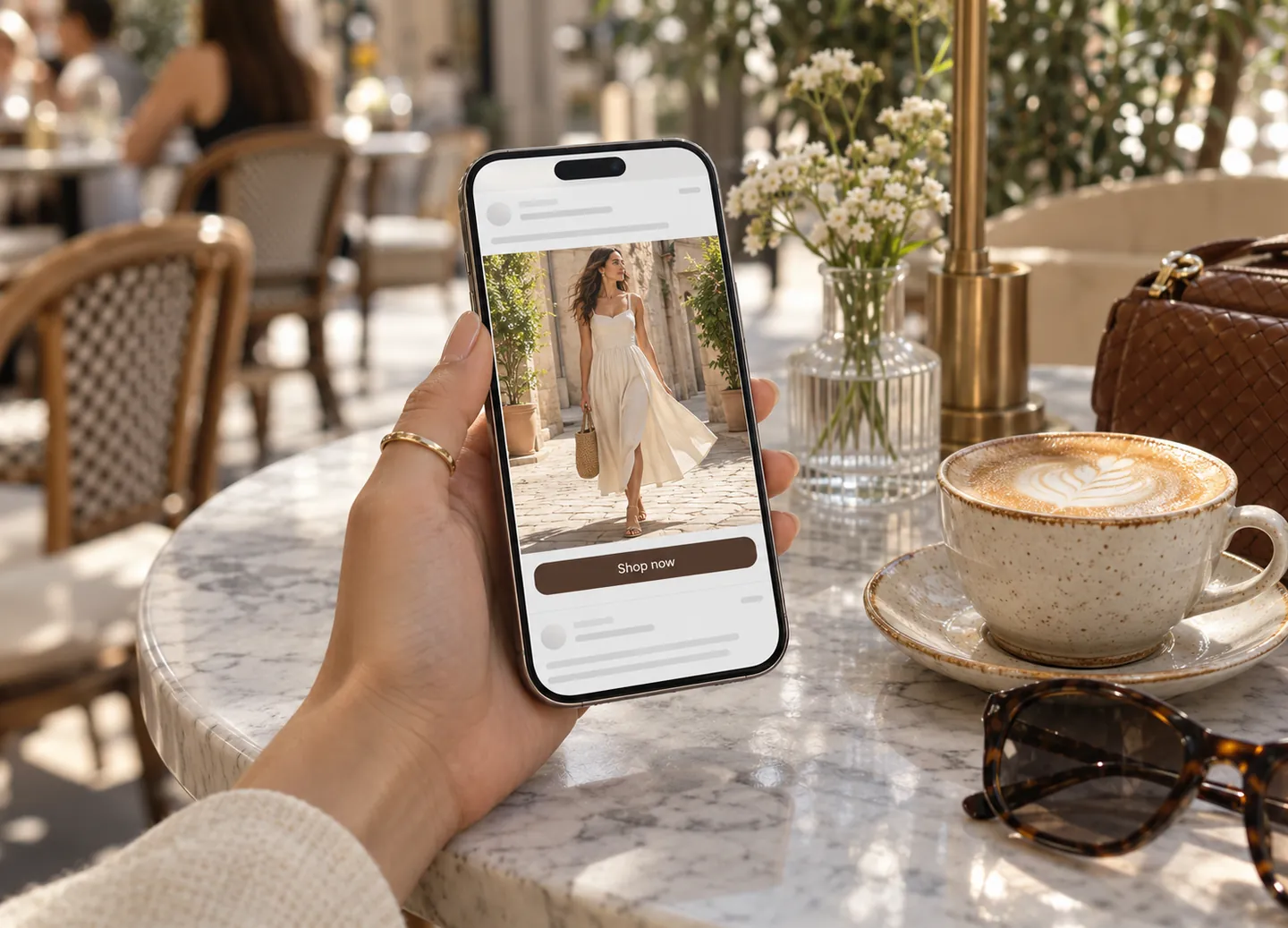
A creative system, not a one-off shoot
Most ads stop working within weeks. The fix isn’t one brilliant campaign. It’s a steady supply of new ideas, tested quickly, with the winners scaled and the losers switched off without debate.
How a week of creative works
We start from angles: the different reasons someone buys from you. A linen dress can be sold on staying cool in the heat, on travelling without creasing, on looking polished at work or on the founder’s story. Each angle gets several hooks, the first two or three seconds that decide whether anyone keeps watching. Each hook gets made in the formats that suit it.
| Format | Best for | What we usually test |
|---|---|---|
| Product demo video | Products with a visible benefit | Different opening shots and problem set-ups |
| Creator or customer video | Building trust with new buyers | Different creators saying the same script |
| Founder story | Brands with a clear origin | Short versus long, face-to-camera versus voice-over |
| Comparison static | Crowded categories | Which competitor, which claim, which layout |
| Carousel or collection | Wide product ranges | Product order and the first card |
Every ad follows a naming convention, so results can be read by angle, hook and format rather than ad by ad. After a few months, you know which messages sell, and that knowledge feeds your site, your email and your Google ads too.
Account structure
Simple accounts scale better on Meta. Too many campaigns split the data so thinly that nothing exits the learning phase. We usually run:
- A testing campaign with a fixed budget, where new creative proves itself.
- A scaling campaign, often Advantage+ for ecommerce, holding proven ads and most of the budget.
- A retention or offer campaign only when there’s a real reason, such as a launch or seasonal sale.
For Shopify stores we set an existing-customer budget cap where it’s available, so Meta can’t inflate results by selling to people who would have bought anyway.
Signal quality and the Conversions API
Browser tracking alone misses a growing share of conversions because of ad blockers, privacy settings and short cookie lifetimes. The Conversions API sends events from the server as well, so Meta sees more of what actually happened.
For Shopify stores
We set up the Conversions API through Shopify’s Facebook and Instagram channel at maximum data sharing, or through server-side tagging when you need more control.
Deduplication
Browser and server events share an event ID, so each purchase is counted once.
Event match quality
We send the customer details Meta needs to match events, hashed, and track the match score every week.
For lead-based businesses
CRM stages such as qualified, booked and won go back to Meta, so the system learns what a good lead looks like.
Lead ads or landing pages?
Meta’s instant forms are fast and cheap, which is the problem: it’s very easy to fill one in by accident or out of mild curiosity. Landing pages ask for more effort and usually bring better leads.
| Instant form | Landing page | |
|---|---|---|
| Cost per lead | Lower | Higher |
| Lead quality | Mixed unless set up carefully | Usually higher |
| Best for | Simple offers, local services, quick callbacks | Higher-ticket services, B2B, anything that needs explaining |
| How we improve it | Higher-intent form type, qualifying questions, instant follow-up | Message match with the ad, short form, fast page, clear next step |
We often test both. What decides the winner is cost per qualified lead or booked appointment from your CRM, never cost per form fill.
Measuring Meta honestly
Meta’s own reporting is one view of the truth. To make budget decisions you need a few more.
- Total revenue against total ad spend (often called MER), checked weekly against Shopify.
- New-customer revenue, because selling to existing customers is cheaper and shouldn’t get the same credit.
- Post-purchase surveys asking “where did you hear about us?”, which often show Meta doing more than click tracking suggests.
- Lift or holdout tests when budgets are big enough, to measure what Meta adds rather than what it claims.
Your first 90 days
- Weeks 1–2
Audit
Account structure, tracking, creative history and what your past winners have in common.
- Weeks 2–4
Fix the signal
Conversions API, deduplication, event values and a simpler campaign structure.
- Weeks 4–8
Creative testing
The first rounds of angles and hooks, with weekly readouts of what worked and why.
- Weeks 9–12
Scale
Proven ads move into the scaling campaign and budget grows as long as results hold.
Questions about Meta Ads
How much creative do we need?
For most accounts, three to eight new ads a week keeps learning going without overwhelming the budget. Bigger accounts need more. We plan the volume with you, and we can source creators or edit your existing footage if you don’t have an in-house team.
Do you make the ads?
We write briefs, hooks and scripts, edit footage and design statics. For new filming we work with UGC creators or your own team. You approve every ad before it runs.
Should we use Advantage+ campaigns?
Often, yes, especially for stores with steady purchase volume. Smaller accounts or ones with very different product lines sometimes do better with a more manual setup. We test both before committing.
Why don’t Meta’s numbers match Shopify?
Meta counts a sale if someone clicked or viewed an ad within its attribution window, while Shopify credits the last visit. Neither is wrong, they answer different questions. We report both, plus total revenue against total ad spend, so you see the full picture.
Can Meta work for B2B or high-ticket services?
Yes, with the right setup. Higher-intent forms, qualifying questions and CRM outcomes sent back to Meta make the difference between cheap junk leads and real pipeline.
Get a second opinion on your Meta account
We’ll look at your structure, tracking and creative history, and tell you what we’d change first.
Works well alongside
Get a free audit
Tell us a little about your business. A strategist will look at your site and accounts, then come back within one business day with a time to talk.
What happens next
- We look over your site and public ad activity before we speak.
- On a 30-minute call we walk through what we found and where money is leaking.
- You get a written 90-day plan. It’s yours whether or not you hire us.
Prefer email? Write to theadstroke@gmail.com